
General Information & Intended Use
What are QED Contrast Media Warmers used for?
Are QED Contrast Media Warmers medical devices?
Can these warmers be used for fluids or blankets?
Can the door be hinged on either side of the cabinet?
Temperature & Performance
What temperature do QED Contrast Media Warmers operate at?
How stable is the temperature?
How long does the cabinet take to warm up?
Operation & Daily Use
Does the user need to set the temperature?
Can the temperature briefly exceed 37 °C during warm-up?
How long does contrast media take to reach temperature?
How long can I leave the cabinet on for?
Loading & Storage
How should contrast media be loaded into the cabinet?
Should contrast bottles be stored upright?
What type of shelves should be used?
Safety & Restrictions
Can QED Contrast Media Warmers be used to warm blood or blood products?
Do the cabinets include over-temperature protection?
Can the cabinet be used in any environment?
Cleaning & Maintenance
How should the cabinet be cleaned?
What should be done if fluid spills inside the cabinet?
Is routine servicing required?
Troubleshooting & Support
What should I do if the cabinet powers on but does not heat correctly?
Are users allowed to repair the cabinet?
How can technical support be accessed?
General Information & Intended Use
What are QED Contrast Media Warmers used for?
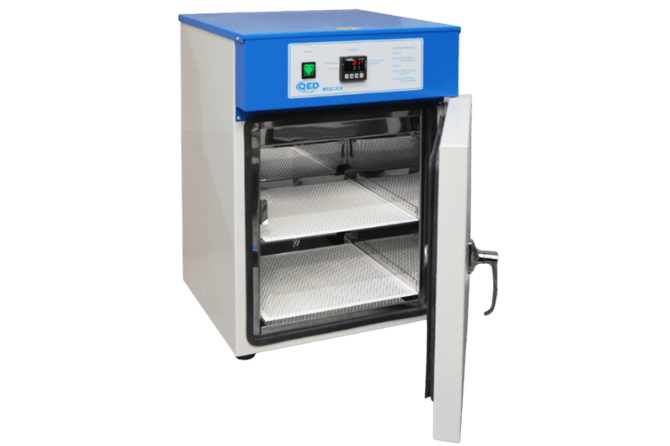
QED Contrast Media Warmers are designed to warm bottles of contrast media to body temperature (37°C) prior to clinical use.
Are QED Contrast Media Warmers medical devices?
No. These cabinets are Class I electrical appliances and are not classified as medical devices.
Can these warmers be used for fluids or blankets?
No. Contrast Media Warmers are intended only for contrast media. Fluids and blankets must be warmed using the appropriate QED Fluid or Blanket Warming cabinets.
Can the door be hinged on either side of the cabinet?
Yes. The door is hinged on the right side of the cabinet as standard, but it can be hinged on the left side.
Temperature & Performance
What temperature do QED Contrast Media Warmers operate at?
They operate at a fixed temperature of 37 °C. This temperature is factory set and cannot be adjusted by the user.
How stable is the temperature?
The cabinet maintains a highly stable temperature, typically within ±0.2 °C.
How long does the cabinet take to warm up?
From cold, the cabinet typically reaches operating temperature in under 20 minutes. After opening the door, temperature recovery is usually under 3 minutes.
Operation & Daily Use
Does the user need to set the temperature?
No. The cabinet automatically regulates to 37°C once powered on.
Can the temperature briefly exceed 37°C during warm-up?
Yes. During initial warm-up, the displayed temperature may temporarily rise above the operating temperature. This is normal and resolves once the cabinet stabilises.
How long does contrast media take to reach temperature?
Warming time depends on bottle size, starting temperature and cabinet loading. Items require sufficient time to equilibrate, so advance planning is recommended.
How long can I leave the cabinet on for?
The cabinet can be left on as long as needed, there is no time limitation on operation.
Loading & Storage
How should contrast media be loaded into the cabinet?
-
Do not overfill the shelves
-
Ensure airflow is not restricted
-
Distribute items evenly
Incorrect loading can result in uneven warming or temperature instability.
Should contrast bottles be stored upright?
Yes. All bottles must be stored upright. Opened, partially used or unpackaged bottles must not be placed in the cabinet.
What type of shelves should be used?
Small contrast media bottles should be stored on perforated shelves to allow correct airflow. These are supplied as standard with Contrast Media Warmers.
Safety & Restrictions
Can QED Contrast Media Warmers be used to warm blood or blood products?
No. These cabinets must never be used to warm blood or blood products.
Do the cabinets include over-temperature protection?
Yes. The cabinet includes automatic overheat protection and a secondary failsafe thermal cut-out.
Can the cabinet be used in any environment?
No. The cabinet must not be used in volatile or potentially explosive environments.
Cleaning & Maintenance
How should the cabinet be cleaned?
The cabinet should be disconnected from the mains and cleaned using a soft damp cloth or approved disinfectant wipes. The door should be left open to allow safe drying before reuse.
What should be done if fluid spills inside the cabinet?
The cabinet must be immediately disconnected from the mains, removed from use, cleaned and checked for electrical safety before being returned to service.
Is routine servicing required?
Yes. Annual inspection and calibration by a qualified engineer is recommended to ensure safe and accurate operation.
Troubleshooting & Support
What should I do if the cabinet powers on but does not heat correctly?
Check the displayed temperature, loading arrangement and ensure airflow is not obstructed. If the issue persists, switch off the cabinet and contact us for support.
Are users allowed to repair the cabinet?
No. There are no user-serviceable parts. All repairs must be carried out by trained and competent personnel.
How can technical support be accessed?
Technical assistance is available. When requesting support, the cabinet model and serial number should be provided.