
General Information & Intended Use
What are QED Blanket Warmers used for?
Are QED Blanket Warmers medical devices?
What types of blankets can be warmed?
Can the door be hinged on either side of the cabinet?
Capacity & Storage
How many blankets can a QED Blanket Warmer hold?
Why isn’t blanket count always accurate?
Is there a recommended fill level?
Temperature & Performance
What temperature range do QED Blanket Warmers operate at?
How stable is the internal temperature?
How long to reach operating temperature?
Can the temperature overshoot initially?
Operation & Controls
How do I set the operating temperature?
Is there overtemperature protection?
How long can I leave the cabinet on for?
Safety & Electrical Information
What electrical supply is required?
Can they be used in flammable environments?
Can users repair them?
Energy Efficiency & Sustainability
How energy efficient are QED Blanket Warmers?
Does keeping the cabinet full save energy?
Are QED cabinets sustainable?
Patient Benefits & Clinical Outcomes
How do warmed blankets benefit patients?
Loading & Best Practice
How should blankets be loaded?
How long do blankets take to fully warm?
Cleaning & Maintenance
How do I clean the cabinet?
How often should it be serviced?
Troubleshooting & Support
What should I do if the cabinet isn’t heating properly?
What if the fan is noisy or airflow seems low?
General Information & Intended Use
What are QED Blanket Warmers used for?
They are designed to warm hospital cotton blankets and drapes to improve patient comfort and support normothermia in clinical settings such as maternity wards, theatres, recovery, critical care and emergency departments.
Are QED Blanket Warmers medical devices?
No - they are Class 1 electrical appliances, not regulated as medical devices.
What types of blankets can be warmed?
Only hospital cotton blankets and drapes should be warmed. Avoid synthetics to prevent safety and performance issues.
Can the door be hinged on either side of the cabinet?
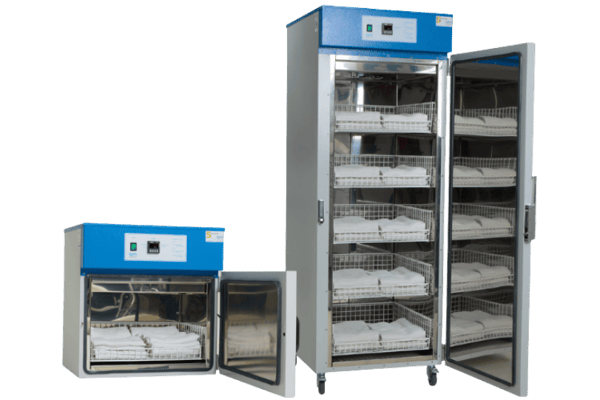
Yes. The door is hinged on the right side of the cabinet as standard, but it can be hinged on the left side.
Capacity & Storage
How many blankets can a QED Blanket Warmer hold?
Blanket count depends on blanket thickness and size. Approximate minimum capacities using large blankets are as follows:
-
BW50: ~3 blankets
-
BW75: ~4 blankets
-
BW150: ~10 blankets
-
BW240: ~24 blankets
-
BW355: ~25 blankets
-
BW575: ~50 blankets
Why isn’t blanket count always accurate?
Blanket sizes vary widely. We recommend focusing on internal dimensions and the number/adjustability of baskets rather than raw blanket counts to choose the best cabinet for your needs.
Is there a recommended fill level?
Yes - cabinets include a ‘Max Fill Level’ indicator to prevent overfilling that could block airflow and reduce performance.
Temperature & Performance
What temperature range do QED Blanket Warmers operate at?
They can be set up to a maximum of 80 °C, controlled by a digital PID controller.
How stable is the internal temperature?
Temperature is typically stable within ±0.2 °C, with the PID controller regulating to the set point.
How long to reach operating temperature?
Warm-up from cold generally takes less than 30 minutes and recovery after opening is typically under 3 minutes.
Can the temperature overshoot initially?
Yes - a slight overshoot during initial warm-up is normal before settling to the set point.
Operation & Controls
How do I set the operating temperature?
Use the digital controller:
-
Press P
-
Adjust with ▲/▼
-
Press P to save
The cabinet will maintain the set temperature automatically.
Is there overtemperature protection?
Yes - both automatic overheat limit and a secondary fail-safe thermal cut-out are included for safety.
How long can I leave the cabinet on for?
The cabinet can be left on as long as needed, there is no time limitation on operation.
Safety & Electrical Information
What electrical supply is required?
They must be connected to a fused, earthed mains supply (max 13 A).
Can they be used in flammable environments?
No - they should not be used in volatile or flammable environments.
Can users repair them?
No. There are no user-serviceable parts; all repairs must be conducted by qualified technicians.
Energy Efficiency & Sustainability
How energy efficient are QED Blanket Warmers?
Energy use depends on:
-
Cabinet size (larger units draw more power)
-
How often cold items are loaded
-
The ambient environment (warmer rooms require less energy)
For example, a small unit (~30 L) could use ~9.25 kWh/24 h at full power, whereas a larger ~575 L unit could use ~48.85 kWh - but actual use is often lower as units regulate rather than run full-time.
Does keeping the cabinet full save energy?
Yes - a fuller cabinet is more efficient because the thermal mass of the blankets helps maintain temperature with fewer heating cycles.
How does room environment affect energy use?
In warmer clinical areas (e.g., maternity wards), the unit uses less energy to maintain temperature versus cooler, air-conditioned spaces like operating theatres.
Are QED cabinets sustainable?
Yes. They are designed for long service lives (often 15-20 years) and most of the cabinet (~95%) can be recycled at end of life, reducing environmental impact over time.
Patient Benefits & Clinical Outcomes
How do warmed blankets benefit patients?
Warm blankets support normothermia, reducing risks such as infection, bleeding and slow recovery - and they improve comfort and patient satisfaction. Warmed items can even reduce reliance on active warming systems during recovery.
Loading & Best Practice
How should blankets be loaded?
Load blankets evenly without overfilling and ensure airflow is not obstructed. Use the supplied baskets to help organise blankets properly.
How long do blankets take to fully warm?
Time depends on cabinet set-point, blanket mass and initial temperature. For best results, stock cabinets ahead of peak usage periods.
Cleaning & Maintenance
How do I clean the cabinet?
After disconnecting from mains, clean with a damp cloth or approved disinfectant wipes. Leave the door open to dry before switching back on.
How often should it be serviced?
Annual preventative maintenance and calibration by a qualified engineer is recommended.
Troubleshooting & Support
What should I do if the cabinet isn’t heating properly?
Check set vs actual temperature, loading and airflow. If problems persist, contact support for assistance.
What if the fan is noisy or airflow seems low?
A failing fan motor can cause this - switch off and arrange service immediately.